11 September 2007

Letters to the Editor

Trade magazines love to excite controversy in their editorials, possibly because the existence of a new mounting package for a resistor or perhaps a new angle for a screw thread doesn't have the verve of a sex scandal or the excitement of a land speed record. If things are slow, a gratuitous comment about immigrant engineers or an advertisement with a scantily clad human female holding a voltmeter is sure to draw out forces for good in the community with the predictable and polarized responses.

The editor of Design News is a bit of a whiner. In a March 2006 issue she delivered a somewhat intemperate diatribe about a misbegotten schnurg who had the temerity to use his Blackberry while attending a press conference. Worse, he was sitting next to her. Evil incarnate! I would have ignored this editorial (as I do most) but since this particular issue of the magazine had a cover article on hybrid vehicles, I thought it would be nice to slip in a notice for my web site. Hence the letter below, published in the 10 April 2006 issue.

IT'S THE RULES THAT ANNOY ME

I just read your Blackberry editorial and can only ask "Why the fuss?" The "user" was operating a chair, not a motor vehicle. He was pressing buttons quietly, not bellowing into a cell phone. He wasn't paying attention at a press event, presumably missing the vital information that will propel you and the other rule followers to the top while he sinks into the muck.

Rather than find it "intensely annoying" when people show contempt for rules, I find it distressing that so many rules are promulgated. If a rule serves a useful purpose, e.g., "turn off the cell phones," OK. If its effect is simply to be meddlesome or officious, I prefer to think of it as an opportunity for entertainment.

And, speaking of entertainment, take a look at www.PriUPS.com — it goes perfectly with your lead article about using hybrid vehicles for power.

Richard Factor Little Ferry, NJ

Which is not to say that I disavow any part of my letter. I truly feel there's too much of this bothersome rulemaking going on. If you are thinking of promulgating a ukase, here's free advice:
  • Is the putative rule both of actual value and not overbroad?
  • Will it be entertaining for you to watch people trying to obey it?
If you can't answer yes to either question, find some other activity to take your mind off the urge until it passes.

By the way, my rule, Conservation of Text, isn't really in either category, but it is mine.

10 September 2007

The Furniture Phase

I fear that I have been wrong. Many years ago I derived a "law" from observation. This law of nature is stated simply: No matter how expensive, complicated, useful, impressive, or downright spectacular a technological product may be, it will soon be obsolete and find its "highest and best use" as furniture.

Examples:
  • Old teevee sets can be used to support flowers, knicknacks, and, of course exploding penguins. With a modest effort they can be turned into cabinets or even aquaria.
  • I still use a CRT monitor in certain applications because it can support equipment on top of it - try that with an LCD flat screen.
  • Not so long ago, a 10Megabyte (5 fixed, 5 removable in a cartridge) "Winchester" disk drive was the standard in corporate data processing. The HP drive I still have has a lovely wooden top and to this day serves as a fine table.

Alas, with the speed of light as a limitation, for our gadgetry to get faster, it must also become smaller. Many of today's prized items — game consoles, radios — might be made to serve as bookends. (Books?)

But when we start using eyeglass displays that paint information directly on the retina or when a single disk drive can store all the accumulated knowledge of the Krell, our reality will become so virtual that it will be necessary to deliberately make such things as tables and cabinets out of raw materials such as trees. If, of course, we still need furniture.

This is a Test

Put the following terms in order, lowest frequency to highest frequency:

___Extra High Frequency

___Ultra High Frequency

___Very High Frequency

___Super High Frequency

Pencils down. Are you SURE you have them in the right order*? Unless you looked it up, or work with microwaves daily, all you think you can be sure of is that "VHF" is the lowest, and maybe "UHF" is next, since you've heard of both. But shouldn't Ultra be the highest? And which is higher, Extra or Super? Fact is, calling frequencies by names makes almost no sense. Each stands for a range of of numbers, and keeping them in order when you know what the numbers are is a lot easier. But these things get started benignly, i.e., with "VHF," and suddenly we're trapped when we need to go further than expected.

What got me started on this rant against the silliness of naming frequency ranges? It was the incomprehensible scheme of abbreviations for computer monitor resolutions. The resolution of a computer monitor is a pair of numbers which tell how many "pixels" it will display. For example, the standard 15 inch LCD monitor has 1024 pixels horizontally and 768 pixels vertically. It's resolution, therefore, is denoted as 1024 by 768. Its area is determined by multiplying the horizontal and vertical pixel count. And this number is tells you how much information the monitor will display. If you consider 1024 by 768 as your reference, then a 1280 by 1024 monitor will display about 1.7 times as much data. This is really simple math. Even CNN employees can probably look at monitor resolution and determine how much data it will display compared to a monitor with different specifications.

At least they could if the monitor's resolution was stated as a pair of numbers. But guess what! Instead of this pellucid scheme, we are treated by the computer industry to the following:

QVGA VGA SVGA XGA WXGA SXGA WSXGA or WXGA+ SXGA+ WSXGA+ UXGA WUXGA QXGA WQXGA QSXGA WQSXGA QUXGA WQUXGA HXGA WHXGA HSXGA WHSXGA HUXGA WHUXGA

Thanks to WIKIPEDIA you can look them all up. As an example, HXGA an acronym for Hex[adecatuple] Extended Graphics Array. Or, I suppose, you could say "4096 by 3072." But why would you, when you could obscure the information by this idiotic miasma of alphabetical obfuscation?

One minor computer extravagance of mine is the desire for a monitor with lots of room to display data. In fact, I typically put two monitors on a computer, and might even use more if the process weren't so confusing. I'm always perusing monitor ads looking for high resolution at a good price. And whenever I find an ad that makes the resolution impossible to determine without research, I ignore it. Take that, Mr. Advertiser (not to mention names, CompUSA).

I would end this screed here, but I mentioned the theme of today's blog to my friend Terry, who came up with such a marvelous example of graduational obscuritanism that I feel compelled to offer it here. Ready?


Descriptive Name
Atlas
Super Mamouth
Mamouth
Super Colossal
Colossal
Giants
Extra Jumbo
Jumbo
Extra Large
Large
Superior

Presumably "Mamouth" is actually "Mammoth," but who knows? Certainly not I, because I don't purchase olives, whose sizes are incomprehensibly listed above! Is Starbucks a piker or what?


*Find the correct order at this electromagnetic spectrum summary.

The Monopolists In Your Wallet

Not counting your national government, which has a presumably legitimate monopoly on the creation of currency, you are also most likely bearing the avatars of some of the largest and most rapacious monopolies extant. These monopolies are so powerful that they absorb tens of billions of dollars of money every year without a peep of complaint, either from the government trust busters, or in most cases, the lickspittle cliques of appeasers in the ranks of merchants and consumers. Yes, that's YOUR money they're absorbing!

I refer, of course to the credit card companies. And that paragraph you just read is, of course, quite the exaggeration. You're actually giving your money to them. Willingly.

What are you babbling about? I love my credit cards and would be lost without them! And those year-end rebates - I love spending them at exotic places I fly to with my frequent-flier miles that I also get from the credit cards.

You fool! Don't you realize they're poisoning your mind and draining your precious bodily fluids? We have got to stop them! (Time for my meds??? Already? OK...)

OK, I'm a little calmer now. Let me 'splain. To begin with: I don't hate credit cards or credit card companies. They perform a number of valuable services, including facilitating online commerce and eliminating the necessity of carrying that unsightly cash. Well, at least one important service, anyway. And, it should be no surprise, they make money doing this. When you buy something with a credit card, you get billed $100 and the CC company gives the merchant $98*. They keep the difference, which goes to pay their expenses, which are similar to those of any business. They include salaries, rent, profit, frequent flier miles, and the $1 rebate to you. In effect, the merchant is giving you a discount for using your credit card. The poor guy paying cash gets nothing.

So what's the problem?

You, Mr. CC fan, just paid $99 for your $100 purchase. The guy who paid cash just paid $100 for his $100 purchase. But you both only got $98 worth of stuff! Why? Because Mr. Merchant, a fellow who enjoys eating food with real utensils in a home with the normal complement of walls and appurtenances, knows that if he gives $2 to the CC company, he can only give you $98 worth of stuff for your $100.

So what's the problem?

Let's say Mr. Merchant sees an opportunity to make a few extra bucks. He offers a $1 discount to cash purchasers. He thinks, not surprisingly, that a cash buyer will buy from him rather than pay $100 elsewhere. The cash buyer saves a buck, the merchant makes a buck.

So what's the problem?

Mr. Merchant can't do that! He is forbidden to by the credit card company contract. Can I make that pellucid? The CC company is telling an independent merchant how he may conduct business with a third party, business that does not involve the use of a credit card!

That's the problem, or at least the first half of the problem.

The second half is that you and I can't start a new credit card company with a different business model. Let's say that we decide there would be a good opportunity for a credit card that would offer immediate rebates. Instead of giving the user a 1% rebate at the end of the year, we'll give it to him when he makes a purchase. Is this a good idea? Will it work? I would think so; I'd rather have a dollar now than a year from now; perhaps others feel that way too. Our new credit card will be a roaring success. Or not. We're capitalists and entitled to take a risk on starting a business with a different model. But whoops - we can't do this. Not because we're unable to, not because the merchant doesn't want to, not because it's illegal, but because a third party - the original credit card companies, have by their actions prevented the merchant from contracting with us. How so? The merchant can't discount his goods to someone paying with the new RIKL card. (It was my idea: I get to name it, you get to supply the startup funds. We're still capitalists here.)

Well, then, can we offer a card that DOES allow the merchant to offer a discount for cash? Sure, if you can imagine a counter clerk saying "If you don't pay with the VISA card, it's $100, but if you don't pay with the RIKL card, it's only $98." In fact, no business model that allows the customer to pay a different amount based on which card he uses, or whether he uses a card at all, is permitted.

If a brief summary will help:

1: One party tells a merchant how he can deal with his customers, whether or not that party is involved in the transaction. Monopolistic and in most cases, illegal.

2: One party prevents contracting with another party since their contract terms preclude different terms with anyone else. Monopolistic.

3: The one party, in aggregate, has an overwhelming share of the market, making it impossible for the merchant to cast them aside if he doesn't like their terms, and he has no power or option to negotiate different ones. Monopolistic, or at least oligopolistic, a distinction without a difference in this case.

If a brief analogy will help:

In most states, when you make a purchase, you get dollar's worth of goods for $1.05 to $1.10. The difference, of course, is called "sales tax." And it's collected by the state government, which has passed the tax laws and owns jails. In effect, the CC companies are also collecting a tax, the 2% difference between the "proper" price of the goods, and the price the customer must pay. Perhaps you remember voting them into office; I don't.

If you've been following (casually) the recent lawsuit by merchants about credit card fees, I should point out that the discussion above has nothing to do with that. That lawsuit seems to be more about the amount of the fees than the terms of the contract. However, if the contract terms were modified to eliminate the monopolistic practices I decry, this lawsuit would lose its relevance. The CC companies could charge whatever they care to, the merchants could compensate by charging more for CC transactions, and the customers would make the final decision by paying either with their card or with a check, currency, pieces of eight, or goats and chickens. The point is, everyone gets to choose what's best for them - the decision isn't made by the credit card company. Many people, myself included, would prefer the benefits and protections of a CC transaction for, say, an online or eBay purchase, and would happily pay the surcharge. I just don't think that surcharge is warranted, and should not be decreed, for every enterprise that accepts credit cards.

Pegged the rantometer today!

*The numbers and percentages I'm using are for clarity. They are not the exact amounts which vary all over the place and you can bet are calculated to the penny and small fractions thereof.


Follow-Up:

Guess what? The above rant is not entirely accurate. In fact, you can't surcharge credit card sales, but you can discount sales for cash. Why didn't I know it when I originally wrote this? Because it's a double-secret, that's why!

09 September 2007

The Oblivious Poet

So this friend of mine sent me (for the second time, just from him, not counting all the others,) a compendium of Jewish haikus. You've seen it. Of course you've seen it. Among them was the oldie but goodie,

Lacking fins or tail
the gefilte fish swims with
great difficulty.

I chided him with the instant response "Been making the rounds for years. I thought gefilte fish swim in jelly." I swear I didn't give it an instant's thought. Really.

He's more compulsive than I remember him to be. He counted the syllables and informed me that my reply was "cool." It took me longer to understand that I had written a haiku than it took me to write it.

My putative limericks never scan properly. Perhaps I picked the wrong poetic form in which to express myself.

Speaking of Death...


I'm sad to report the tragic death of the Sky Bar as I know it. This chocolate-of-my-youth has become a casualty of (I'm guessing) manufacturing efficiency. Behold the new Sky Bar!


Back when you could buy one for a nickel in a subway vending machine, the individual segments were lovingly filled with the appropriate confection. Different flavors! Different consistencies!


Now it even looks more homogeneous. The individual compartments have essentially identical consistencies and all taste the same. The peanut butter lacks grit, the fudge lacks firmness, the vanilla is 100% flavor free, and the caramel? Not even gooey!

I'm never going to buy another case of these, assuming I live long enough to finish the one I just got. (Which I shall so attempt. They're still chocolate, right?)

And — not that everything was better back then — but neither I nor anyone on earth cared that our Sky Bars were manufactured "IN A FACILITY THAT ALSO PROCESSES TREE NUTS."

Keep Your Radio Station in a Shoe Box

I've been "tasked" to write 300-400 words for a "product spotlight." I wonder if the domestic equivalent of "tasked" is "honeydewed." Today's blog, therefore, is an advertisement. I am not going to waste the result of a "tasking" for purely commercial purposes.

Back when I worked in radio, we would record each day's programming on a "Soundscriber" tape. These tape reels were large, hard to store, and sounded glitchy. Locating something you wanted to hear first required estimating how much tape was on each reel. As unpleasant as this process was, those tapes were precious. After all, they were our station! Once a signal goes out over the air, without a recorded log it's gone forever. You spend millions of dollars a year, not to mention your creativity and zeal, creating something unique and — without a recording — pfft*! If somehow I had access to a modern Eventide VR615 logger back then, I would have bought it myself, brought it home, and made sure that I would personally have complete memories of those exciting days.

Well, I didn't and no longer do. But you do and you can. And, with any luck the station will spring for the logger so you don't have to. Things happen on the air. When they do, you want to be able to recreate them if necessary, or just remember them if not. (And sometimes, sad to say, you may need to prove they did or didn't.) Your log archives are your station and unless radio is just a job to you, they're also your life!

A dedicated, reliable, multi-channel logging recorder is more necessary than ever for the usual reasons: No, he didn't say that. Yes, we did run that spot at 08:32. Hey - check out that new sponsor on our competitor's morning show. Choose a logger with full-bandwidth capability (did we mention the VR615?), and you can even rebroadcast old programs when they are suddenly news again. Choose a logger that can deliver audio over your local network and everyone at the station can excerpt your (or your competitor's) programming without assistance. Choose a logger that can deliver audio over the internet and "live monitor" your station (or any connected local station) anywhere in the world. Choose a dedicated, rack-mount logger that is designed to integrate into the broadcast engineering environment so you don't have yet another PC to administrate in your spare time. (Yes - I'm certain we mentioned the VR615.)

But most importantly, choose a logger that conveniently makes sequential and permanent archives on inexpensive, flat, easily-stackable media. Your future self will thank you, and when you are asked if you've ever had amnesia, you can point to your shoebox instead of saying "I don't remember."


*Yes, it's in the dictionary!

The Ticking Clock

Do you remember the building of the Berlin Wall? Do you even remember the destruction of the Berlin Wall? If you remember both, don't forget to keep doing your mental exercises so you can continue to do so. If you remember only the latter, there's a good chance that the phrase that heads this blogentry is a metaphor for the passage of time, and nothing more.

Huh? Of course that's what it is. The biological clock is ticking, the clock is ticking on this project, the deadline, global warming...

But somewhen, bracketed by the rise and fall of the Berlin Wall, the non-metaphorical clock stopped ticking. Now our clocks are digital. If they look analog, they probably have quartz oscillators driving chip dividers running a liquid crystal display through a display formatter so you can see the mock hands "turning." Cheaper than a spring, gears, and a hand or three.

Even as I "type" this our metaphors are outliving us.

When Cats Learn to Grout

There is no doubt in my alleged mind that some science person out there is right this instant devoting his life to making pigs fly. You tell someone it's impossible and they make it happen. You! Mr. (or Ms.) Science Person! STOP IT! You are wasting your time and genius on this frivolous pursuit. I have a job for you.

There is no reason for a pig to fly. There is every reason for a cat to grout. With snow shoveling season (hopefully) past, it is time to repair the depredations of shovel and storm on the flagstones in the entryway. I could do this, but, inter alia, I'm lazy and don't know how. I could hire someone to do it, but most likely he'd be lazy, not know how, not show up, and want to get paid. It seems to me that one could design a grouting cat. The physical design is already perfect, and compared to a contractor, the cat is much more likely to show up and would work more cheaply.

How about it, Ms. (or Mr.) Science Person? A Nobel prize awaits.

The Fifth Season

I don't drink beer. I have always been grateful, in an odd way, to the beer manufacturers who make it possible for radio stations to remain in business by interminably advertising their product, even while feeling guilty that I have no way of contributing to their coffers.

Today I feel even more guilty, because the Guinness company has not only contributed to my radio enjoyment, they appear to have increased my lifespan. Apparently St. Patrick's Day, a minor holiday of old transmogrified into a day of sozzled celebration and Irish pride* in this past century, has been morphed yet again, this time at the yeasty pseudopodia of Guinness. It seems, according to their radio advertising, that today is the culmination of the "St. Patrick's Day Season!" It isn't exactly clear when this season begins — perhaps contemporaneously with their advertising campaign or maybe when the sun enters buttis the keg — but one assumes that it ends on its eponymous day. And I suppose it runs contemporaneously with the more traditionally-named season, i.e., northern hemisphere winter, giving the lie to my life-extension theory. Perhaps next year, after now having primed us for this calendar extension, they will offer a UN resolution to formalize it. Why not?

Honorable mention to Coors. I would never have had occasion to discover the rich etymology behind "fer shizzle" had I not been paying attention to their recent ads.


*I always wear the green on St. Patrick's day despite a total (so far as I know, of course) lack of Irish heritage. Today's ensemble incorporated a T-shirt with green swirls in an almost disorienting pattern.

08 September 2007

Near-Miss

So here I am driving along minding my own business when this big truck on my left cuts into my lane. Not ahead of me, not behind me, but right next to me! I don't know if he saw me or not, but he's trying to force me into the right lane, and there's a car in the way! Fortunately the truck wasn't changing lanes rapidly and so I was able to disengage the cruise control, slow down to let the car on the right pass, and get into the right lane. If the truck were changing any faster I would have had to use my brakes! I could have been killed! I tried to get his license....Blah blah police blah blah blah truckers should be more blah blah...

And so forth. If you are one of the 300 million drivers in the United States*, your reaction to that story was that after half of the first sentence you stopped paying attention, and if you got to the blah blah blah you were probably just waiting for me to reach the end so you could tell of your own near-death experience. (No, I don't care about yours any more than you care about mine. If you tell me the story after you actually have died, then we may be onto something.)

Someone Cares!

Have I got news for you! There is someone, somewhere, in these great United States who actually cares about your story, and maybe even about mine. He is Dr. Jeffrey Hadley, and he has a mission. After you survive your wild ostrich encounter or whatever, Dr. Hadley invites you to his web site to tell him all about it. Will he read your report? I don't know. But I came across this site and, as usual, have repurposed it, this time converting a valuable, life-enhancing, science-advancing project into a vehicle for personal catharsis. I did not ask Dr. Hadley's permission to do this, but I suspect that anyone who makes honest reports is welcome, regardless of motive.

I commented to him in an email that this is similar to the NASA program in which airplane pilots can report safety hazards and, in effect "immunize" themselves from prosecution if they report a violation before the FAA finds out about it. This is a special boon because most of the safety hazards they report are events in which they are the cause or at least are reluctant participants. The NASA program does have a lot of value, not just for individual pilots but for the airspace system as well. It has probably prevented many accidents and incidents. Of course a similar program for autos can't be the equivalent, in terms of "immunity." If you have a near miss on the highway, the government normally doesn't send you a certified letter three months later asking for an explanation. Even so, Dr. Hadley's mission seems valuable and likely to enhance driving safety.

Whether you have a "routine" near-miss or you drive under an overpass right before an earthquake destroys it, crushing the school bus behind you, please be sure to fill in Dr. Hadley's form. Uniform statistics are dull statistics.


* I am well aware that there aren't 300 million licensed drivers in the United States. It just seems that way. And if you count backseat drivers, screaming kidlets, and restless pets there may well be more.

Astronomy License

Pluto has been demoted from the planetary pantheon. A question immediately popped into my alleged mind: Did Pluto find out about this immediately, or whether, as with all other information transfer, it happened no faster than the speed of light? If so, poor Pluto, orbiting light hours from the sun, was among the last to receive notification! In addition, when I read a Wall Street Journal article prompted by the virtual planetary realignment I realized that there was an even more important issue.
If I understand this correctly:

  • Astrology is used to determine the future of individuals.
  • An important aspect of the science of astrology is the locations and characteristics of the planets.
  • One of the most important characteristics of the planets, it seems, is their sex.
  • As we see below, "A planet's sex is determined largely by the name given to it by astronomers."

  • Which brings me to the obvious and vital question: Can we leave this critical determination to astronomers alone? Or, if we can, should they not have government-issued licenses?

    I can't believe that someone can graduate from astronomy school and be allowed to practice his craft without at least undergoing a state or federal (or other-national) licensing exam*. This is a vital issue, and I believe it is necessary for the candidates of all parties to address it in the forthcoming elections. And if it's brought to their attention, I'm sure they will.


    From the Wall Street Journal, 25 August 2006


    *There is precedent for government regulation in this area. I'm sure you know that the modern haruspex is required by law to use FDA-inspected chickens.

    QVMF

    California is a beautiful state. The Pacific Coast Highway is one of the most beautiful parts of California. Despite the fact that the ocean is on the wrong side of the beach, at least from my East Coast point of view, I would always go to the beach if I had the opportunity when visiting, as I used to do before the evil airline scum took over. I was very adaptable back then.

    One day as I was negotiating an always-almost-full parking lot I saw a license plate that looked very much like the version I recreated below.


    After an instant's puzzlement, its meaning popped into my alleged mind, I indulged myself in a substantial guffaw, and decided that it was the most clever license plate I had ever seen. Although I'll take credit for several clever ones myself, nothing in the intervening decades has changed my mind.

    I kept a lookout to see if the owner of the car was about, but despite the terrible sacrifice of spending a couple of hours on the beach I was never able to locate him. For that reason, I'm not positive it means what I think it means, but it can hardly mean anything else, can it? Perhaps the owner still has its multicolored successor, or fondly remembers it, and will find it here when he does an internet search. I never selected this for a New Jersey plate of my own because I have a more temperate attitude, but I still get a giggle over it, and trust you will, too.

    07 September 2007

    Almost Enough...

    One short week ago I mentioned that "perfect" was a grammatical absolute. It cannot be compared in the sense that something can be "more perfect" than another. I neglected to mention that there is an acceptable comparative: "Almost." A thing can indeed be almost perfect.

    Today we consider "Enough." Although superficially "perfect" and "enough" seem alike, nothing can exceed perfection, yet one can have more than enough as well as less than, or "not enough." Right?

    Perhaps...

    Consider butter: I have long espoused the theory that if put more and more butter on a slice of bread, eventually you will have almost enough. I have never seen a slice with "more than enough."

    Likewise, books. Call my "life" dreary, but for me one of the most anticipated annual events is the local library book sale. Here's how it works, more or less:

    Friday: Hard cover books, $2 paperbacks, $1
    Saturday: Hard cover books, $1, paperbacks, $.50
    Sunday: A bag of books (all you can fit) $2
    Monday AM: A box of books $1
    Monday PM: The book burners show up to clear the room

    I'm a Saturday and Sunday kind of guy. By Monday I have pretty much everything worth getting. Until recently I wasn't allowed to deploy the books from the last three years because the wall behind the new book cases hadn't been painted. (No, I don't understand why that matters, either.) But this should be an especially acquisitive year because empty shelves beckon. The awaited book sale is this weekend! I have mentioned it to friends, some of whom claim they have "enough" books right now and don't need to attend. Others, especially those who have observed my sea of bags of undecanted and obviously unread books from years previous, might be thinking that I, too, might have "enough" books.

    Sure. And I have enough chocolate, enough money, and that slice of bread is fully-buttered.

    The Monversometer

    Do you use the telephone? I used to, and when I did I would occasionally find myself in a monversation. The term defines itself - it's a conversation in which one person does all the talking. Perhaps the other party (you?) would punctuate the occasional brief silence with an uh-huh or similar interjection, sort of like an ACK after a few blocks of text. Or perhaps you were the monversator, satisfied with little more then comfort tone and perhaps a bit of audible breathing.

    I am not one to deliver myself of exhortations on social intercourse. You are welcome to have all the monversations you desire. My goal, which I now undertake with appropriate nerd-like zeal, is to offer the world instrumentation to detect this arguably undesirable condition. Why? Perhaps people can benefit from it! (Certain parental units, for example, might find themselves enlightened when they receive one as a gift.) Perhaps someone will make money from it! (If you want to try, I'll be happy to file a patent application for it if you pay the attorney.) But the real reason is... If I get stuck on the telephone again, at least I'll have something entertaining to look at, and while I'm being entertained I will be less inclined to have the Instrument from Hell crushed.

    How does it work? Simplicity itself! There are really only a few "states" of telephonic babble: One party talking, the other party talking, both parties talking, and neither party talking*. A "good" conversation in most cases is one during which both parties talk roughly equal amounts. Because the telephone electronically disambiguates the talking party simply by noting the signal source**, a few digital timers, one for each talker, and one for the total call length, are sufficient to capture the statistics. Once this information is available, the UI ("User Interface", of course) can be incredibly simple:

    Nice conversation

    You're not sharing!

    One at a time - Play Nice!

    Of course, this is a little too simple for my inner nerd. I would personally prefer a central youhermeter (or a youhimeter, but let's be realistic) with a needle that is nudged in the proper direction by the ebb and flow of the conversation. Ancillary digital readouts could indicate the normalized energy ratio emitted by each conversant, ratio of total silence to total talk, and the exact time. With a modicum of digital signal processing, interesting research could be done by adding recorded clicks, beeps, and subliminal voices to the con- or mon-versation at critical points while performing "voice stress analysis." But I digress.

    While you and I would never be guilty of monversation, many of the people with whom we speak are, and a difficulty arises in getting the device into the hands of those who would benefit most from being aware of their foible. I suppose the simplest way to get one into the right hands is, during a monversation, tell the other party "I'm sending you a gift!" That is, If you can get a word in.


    *The opposite of talking isn't listening. The opposite of talking is waiting.Thank you Fran Lebowitz

    **This is a remarkably difficult problem in cases where the signals can't be separated by some obvious method. A friend wrote a Ph.D. thesis on the subject.

    Elon & Andy

    One blog I read every day is that of Andy Tobias. Partly because it's habit — he's been blogging for ten years, long predating the word itself. But mostly it's because he's managed to keep it interesting and eclectic for that long. (And also partly because we attended the same high school.) In fact, this blog is largely patterned on his, albeit without the politics and a different focus, if you can dignify my blog with the term "focus."

    On Monday, Andy's blog was about an electric car being developed by Elon Musk, an exciting proposed development in transportation if there ever was one. As I occasionally do, I sent Andy an email about that day's blog and, to my surprise, my email became the contents of his blog for Tuesday. Since I wrote his blog, and I practice conservation of text, I simply appropriated it for my blog on Wednesday. Got that?

    Here it is:

    Electric Cars II
    Published on August 22, 2006

    Richard Factor: “I have nothing but admiration for Elon Musk (yesterday’s column). I even used him as an example when I gave advice to Warren Buffett a month or so ago. I’m extremely impressed by his Roadster and follow-on plans. It’s people like him who, at their own expense, prove to the world that great advances are possible. Or perhaps not – obviously some skepticism is warranted in a big project like this. I wish him the best of luck, and may get on line for version 2, or even version 1 if I’m feeling flush. But, I would like to take issue with one brief and gratuitous statement in his article: ‘As a friend of mine says, a world 100% full of Prius drivers is still 100% addicted to oil.’ Perhaps so, but it would be a world addicted to HALF AS MUCH oil, at least as far as transportation is concerned. No more imports! Not to mention a greatly reduced price of gasoline, excess refinery capacity, and the political benefits of not being held hostage to the countries that supply our habit. And I would be irresponsible if I didn’t mention the other benefits of the Prius, as detailed at www.PriUPS.com: ‘Energy independence’ for individual homeowners along with potential benefits for the electric grid in case of terrorism or natural disasters. Of course neither the Prius scenario or an all-electric one will happen overnight. But we know for a fact that hybrids have enormous benefits, and I for one am hopeful that Elon Musk can prove his electric car is both viable and as beneficial as he says.”

    If you didn’t already guess it, Richard loves his Prius. “I routinely get about 50 mpg in mine, in a land where we have winter, and on a commute where there is an elevation change from end-to-end, both of which tend to reduce one’s mileage. Under even better conditions, people report 55 mpg.” You can see a log of his mileage here.

    © 1998, 1999, 2000, 2001, 2002, 2003, 2004, 2005, 2006 Andrew Tobias

    06 September 2007

    Theremin Thoughts

    Time goes by so very fast,
    And you know your younger years won't last,
    So take these childhood dreams as they come,
    And learn to live each day one by one.

    Amazingly, the Blues Magoos lyric above, from 1966 or so, postdates most of this story. I'm not much of a wallower, but I allow myself the occasional bit of nostalgia on the appropriate occasion. This is one of them.

    So far as I know, I have no charisma with musical instruments. I can pick out a tune on a piano (slowly, inaccurately) and know one guitar chord, although I confess that I've forgotten what it's called. However, there is an "instrument" that I once fancied I might be able to play. It's called the "Theremin." The Theremin is played by waving one's hands in space. Its two antennas respond to hand position, one by changing the frequency (pitch) of the emitted sound, the other by changing its amplitude (loudness). It took the actual construction of one of these instruments to disabuse me of any notion that I would be able to coax music from it. I don't recall too many details of the project, although I suspect I found the plans in the then-thriving magazine "Popular Electronics" or one of its plentiful kin. Being somewhat more sanguine about my musical talents then, I decided that my failure might be attributable to the Theremin that I constructed. Perhaps its circuitry lacked sensitivity or stability. (To be sure, that might have been true as well.) I was unable to accomplish anything remotely musical with the device; I couldn't even play along with Good Vibrations because it hadn't been written yet.

    Time went by at a modest rate, my younger years were exhibiting surprising durability, and I was too busy to comply with the Blues Magoos quotation, above, which in any event shared Good Vibrations' lack of existence at that time. Under circumstances I no longer recall, and which were probably fortuitous, I found myself on a pilgrimage to Trumansburg, New York. Undoubtedly the motive was Theremin-related, for Trumansburg was the home and business location of a fellow named Bob Moog, a physicist-turned-tinkerer. Moog was an expert on the Theremin, and was selling them whole and in parts. He had a big room on the ground floor of a building there, and I and a friend dropped in, unexpected and uninvited. Perhaps because public interest in Theremins was less than acute, and Trumansburg was not the metropolis then that it has no chance of becoming now, Moog was hospitable to his visitors, and we enjoyed some conversation and had the opportunity to try a "professional" Theremin.

    I wish I could relate the visit in greater detail, but so many decades have passed that even if this didn't happen in "The Sixties" I'd have a good excuse. I do recall one crucial detail: The curtain. The rear of Moog's space was partitioned by a black curtain. Before we left, we were invited to look behind the curtain. And there we saw his secret project: A device called a "synthesizer." I would love to say that I realized I was in the presence of History, but the closest I will get to saying it is having just said it. I don't remember how similar it was in appearance to the evolved versions we saw in studios and on stage with ELP. Probably not very. And there was certainly no "Minimoog." Moog, in fact, wasn't a noun, just a guy's name. A nice guy, to be sure, who, viewing us as kindred spirits, or perhaps as innocuous, ushered us into the sanctum and showed us the future. Some months later I discovered an article by Moog in the Journal of the Audio Engineering Society which explained the theoretical basis of his synthesizer and, not coincidentally, provided a significant part of the knowledge and impetus that set me on my career path.

    The Blues Magoos wrote their lines. The Beach Boys released Good Vibrations. Although I ended up in a similar business to Bob Moog, we would only run into each other on rare, rushed occasions, and never really had occasion to exchange more than a "Hello." Time went by, accelerated, and has turned into a blur. So much of a blur that when I happened to think of the Theremin, I said to myself "Didn't Bob Moog just die a few months ago?"

    Yes, at least for large values of "a few." Bob Moog died a year ago today. What became of that year I have no idea; I can account for a few days at most. Moog's business, and the industry he helped create continues to exist, but, sadly, one of its founders does not. The System strikes again.

    Moog is dead. Long live the Moog!


    Originally published 22 August 2006

    Scanning the Headlines

    I speak and largely comprehend colloquial English. I know, for example, that when a headline says "Judge to rule on UK bomb suspects," it doesn't mean that a new form of torture has been discovered in which evildoers are transformed by judges into diffraction gratings. Likewise, I understand that in "Boy, 12, boards plane without ticket, passport," it is the boy, not the aircraft, that is deficient in paperwork and that the aircraft probably has its airworthiness certificate and radio license properly displayed. Moving along, I infer that in "Israel may stay for months in Lebanon," the synecdoche refers to Israel only, and "Lebanon" really does mean "Lebanon." For a bit more synecdoche, "Paper sorry for Prince Harry groping pictures," may mean the management of the [news]paper is sorry that Harry was allowed to grope those otherwise pristine pictures, or perhaps, improbable as it seems, they are pictures of Harry performing some act of gropage.

    Which brings us to "Brainy RV def but preppy white posse's whack." The little icon next to it means that it's a video, which further means it takes a lot more than idle curiosity to get me to actually scrutinize it. I asked two people, both of whom are younger and far more hip ("hep") than I am to speculate about the headline's meaning. This resulted in two blank stares.
    If you have a clue as to what this might mean, please let me know! Me? I'm taking the rest of this blogitem off before I find out that Barbaro has been arrested for assaulting the comeback trail.


    Follow-up 23 November 2006


    Why I'll never run out of material...
    "Supermodel Heidi Klum gives birth to Seal's son."

    Perfection-Part II

    Yesterday, you will recall, we embarked on an exploration of the following blurb on a Hershey's Sticks package.

    Perfectly Sized
    60 CALORIES
    perstick

    It might seem that one day would be enough to exhaust the implications of this seemingly innocuous and simple assertion. But no! This is the internet! This is a blog! Be thankful that today will be the end; I could have sent the package out for an analysis of the ink, too.


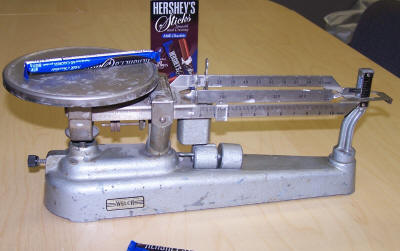
    As I said yesterday, we will try to determine the true meaning of this blurb. On the one hand, the intention of the blurb is to make people buy the product. Implying that it is "perfect" clearly renders all other products inferior, making this the only one to choose. But actually asserting that the product is perfect leaves Hershey open to challenge. So what are they really saying? I believe the key to Hershey's "plausible deniability" should they be accosted with accusations of inaccuracy is the "ly." Recall the thought and effort that goes into packaging. Surely Hershey easily could have used the phrase "Perfect Size." But "Perfectly Sized" has another, literal meaning, and one with which nobody can quibble. If there is a manufacturing specification for the confection, e.g., so many grams of chocolate of a particular blend, in a trapezoidal shape with the two non-parallel faces at such an angle, etc., then any stick that meets the dimensional portion of the specification can truly be said to be "Perfectly Sized." Lacking a chocolate chromatograph or laser interferometer, I decided to confirm only the weight of the individual sticks and try to decide if they conform to specification, i.e., 11 grams each, as designated on the packaging.


    Subjecting the Sticks, one at a time, to Science, I discovered that, wrapped, they weighed 11.5 grams each, exactly, or, dare I say it, perfectly, to the limit of resolution of my 50-year-old triple beam balance. I could not detect any difference in weight among these four exemplars of putative stick perfection. I did not weigh the wrappers separately for fear of damaging the samples by uncontrollable consumption.


    Weighing the remaining four sticks as a group gave 46 grams, again to the limit of resolution, thus not only confirming the scale's linearity, but showing that at least on this scale there is no noticeable variation variation in mass due to mutual gravitation or short-range nuclear effects.
    I believe that this series of measurements constitutes verification that Hershey has succeeded in "perfectly sizing" their product.

    I'd like to make it clear that Hershey isn't unique in their ability to make a consistent product. Indeed, routine manufacturing processes are often turned into product blurbs. "Shot from Guns! Frost Brewed!" The genius here is to take product consistency and turn it into a "perfect" marketing slogan, and we must admire them for that.

    Consistency is a boon that is not always delivered. Remind me to tell you some day about the Swiss Cheese Incident. Not tomorrow? OK.

    05 September 2007

    Perfection

    Every once in a while a stupid marketing slogan catches my eye. I am assaulted with slogans just as you are. They're on packages, magazines, billboards, and almost certainly on the teevee, although I manage to avoid most of those. And, just as you do, I ignore almost all of them. The last one at which I took umbrage was the execrable "You don't have a picture without a print," Hewlett-Packard's attempt to convince candidate customers that printers continue to serve a purpose. I was pleased to see that they vanished it quickly, probably because it was too stupid even for their marketers, or perhaps because David Packard* was sufficiently exercised to remonstrate with them despite that fact that he's technically life-free at this time.


    I arrived home one day recently to discover three different packages of Hershey's brand chocolate somethings on the counter. There were some crunchy items, there were some chocolate wafers whose purpose, so far as I could divine, were intended to help one visualize non-Euclidian geometry, and there were Hershey's Sticks, the subject of this blogitem. I should note that the appearance and therefore my discovery of these packages was a consequence of someone other than myself having "shopped" for them, and this is as good a place as any to proclaim my eternal gratitude to that person (she knows who she is). My immediate reaction to these items was to sample them. My second reaction was to note: "Hmmm. Tastes very much like Hershey's chocolate, but you certainly get a lot less for your money." My third, on examining more closely the refined packaging was: "Perfect?"

    People who know me, some with significant annoyance, will assert that I occasionally read or say something and latch onto it as a subject of conversation, ad nauseam, despite the fact that it is, at best, irrelevant, and often tedious. Such was the case with the blurb on the Hershey Sticks package:


    Perfectly Sized

    60 CALORIES

    perstick


    (I'm sure they mean "per stick" but you're looking at an unaltered photograph.) We know that the amount of agony that consumer firms undergo in designing packaging far exceeds even the tedium of the following exegesis, so I have to believe that, other than the presumptively-accidental anemic spacing, that they have very carefully considered every letter, every point size, and even the slant of the italics. When they print "Perfectly Sized" I think it's safe to say that they didn't just put that in at random.

    "Perfect" is a tricky word. Although we know what it means, we misuse it all the time. It is a grammatical "absolute." If you say that something is "good" or "wonderful" or "excellent," there remains the possibility that the thing next to it is "better." Not so with "perfect," to which there can be no comparison. Yet "more perfect than" is heard all the time. What does it mean to assert that Hershey Sticks are "perfectly sized?" Is it that 60 calories is the perfect size, and that anything that isn't a "stick" of 60 calories, regardless of composition, is somehow of an inferior size? Less sweepingly, is 60 calories the perfect size for a stick of chocolate? Or is it the physical size that is critical, and the number of calories of less significance, i.e., is the blurb unitary or separable?

    Any of these interpretations of the meaning of the blurb might be supportable, but they are all open to external challenge. The package, solely under the control of Hershey's Chocolate, doesn't have a section for rebuttals; neither is there an ombudsman to present alternative takes on perfection to their marketing department. If I, for example, were to assert that 55 calories were "perfect" and 60 calories bordering on the excessive, I would have little chance of compelling a recall. And yet, in these days of consumer activism, class action suits, and tree-nut paranoia, I find it difficult to believe that Hershey would deliberately promulgate so open a challenge to the chocolate eating community, and, more importantly, to their competitors, each with its battery of white-lipped attorneys.

    Tomorrow, I shall try to resolve the "true meaning" of the blurb. Although "true" can be even more slippery than "perfect."


    * David Packard endeared himself to me with a quotation in an interview he undertook before he suffered from the impediment referred to above. He had left H-P to become an undersecretary of defense, and eventually moved on. When asked what was his most significant accomplishment while working for the government, he said "I quit smoking."